New studies suggest that artificial intelligence is becoming more than a productivity tool for teenagers. Millions are now using chatbots not only for information and schoolwork, but also for companionship, emotional support and advice. Researchers say the trend raises important questions about adolescent development, loneliness and the future of human relationships.
A Behavioral Shift Happening Faster Than Most Adults Realize
Artificial intelligence entered mainstream culture as a technological breakthrough.
At first, it was presented as a better search engine, a coding assistant, an image generator and a productivity tool capable of summarizing information in seconds. The conversation around AI revolved largely around efficiency and automation. The biggest questions being asked were economic: Which jobs would change? Which industries would be disrupted? How quickly would businesses adopt the technology?
Those questions remain important. Yet a quieter shift has been unfolding in parallel – one that has received considerably less attention.Teenagers are increasingly using artificial intelligence not only to complete tasks but also to navigate experiences that have traditionally belonged to the realm of human relationships.
They are asking AI chatbots how to approach friendships, process arguments, handle breakups, manage anxiety and understand emotions that they struggle to explain. Some use AI to rehearse difficult conversations. Others use it to seek advice about family conflicts or social situations. A smaller but growing group appears to be using AI for companionship itself.
The trend is emerging rapidly enough that psychologists, educators and adolescent researchers have begun examining what it may mean for emotional development and social behavior.
The speed of adoption alone is remarkable. Generational technological shifts usually take years to reshape behavior. Social media evolved gradually. Smartphones transformed daily life over a decade. Streaming services slowly replaced traditional television.
Artificial intelligence appears to be moving on a different timeline. Within just a few years of becoming widely available, AI chatbots have become part of everyday life for millions of teenagers.
The implications of that change extend beyond technology. They touch education, psychology, relationships and public health. Most importantly, they raise a question that may define this decade of youth development:
Why are so many teenagers increasingly comfortable talking to artificial intelligence about issues that previous generations primarily discussed with other people?
The Numbers Behind Teens Using AI Chatbots
The conversation around teenagers and artificial intelligence often begins with anecdotes.
A teenager uses ChatGPT to complete homework. Someone asks an AI chatbot for relationship advice. A student creates study notes using artificial intelligence. Individually, these examples can appear isolated.
The data suggests otherwise. Several recent studies indicate that AI adoption among adolescents has reached a scale that can no longer be viewed as experimentation.
According to a survey by the Pew Research Center, approximately 64% of U.S. teenagers report using AI chatbots. Nearly one-third say they use them every day.
Another national survey conducted by Common Sense Media found even higher levels of engagement with AI companions. The findings suggest that artificial intelligence has moved beyond novelty status.
For millions of teenagers, AI has become an integrated part of daily digital behavior.
Teen AI Adoption at a Glance
| Metric | Finding |
|---|---|
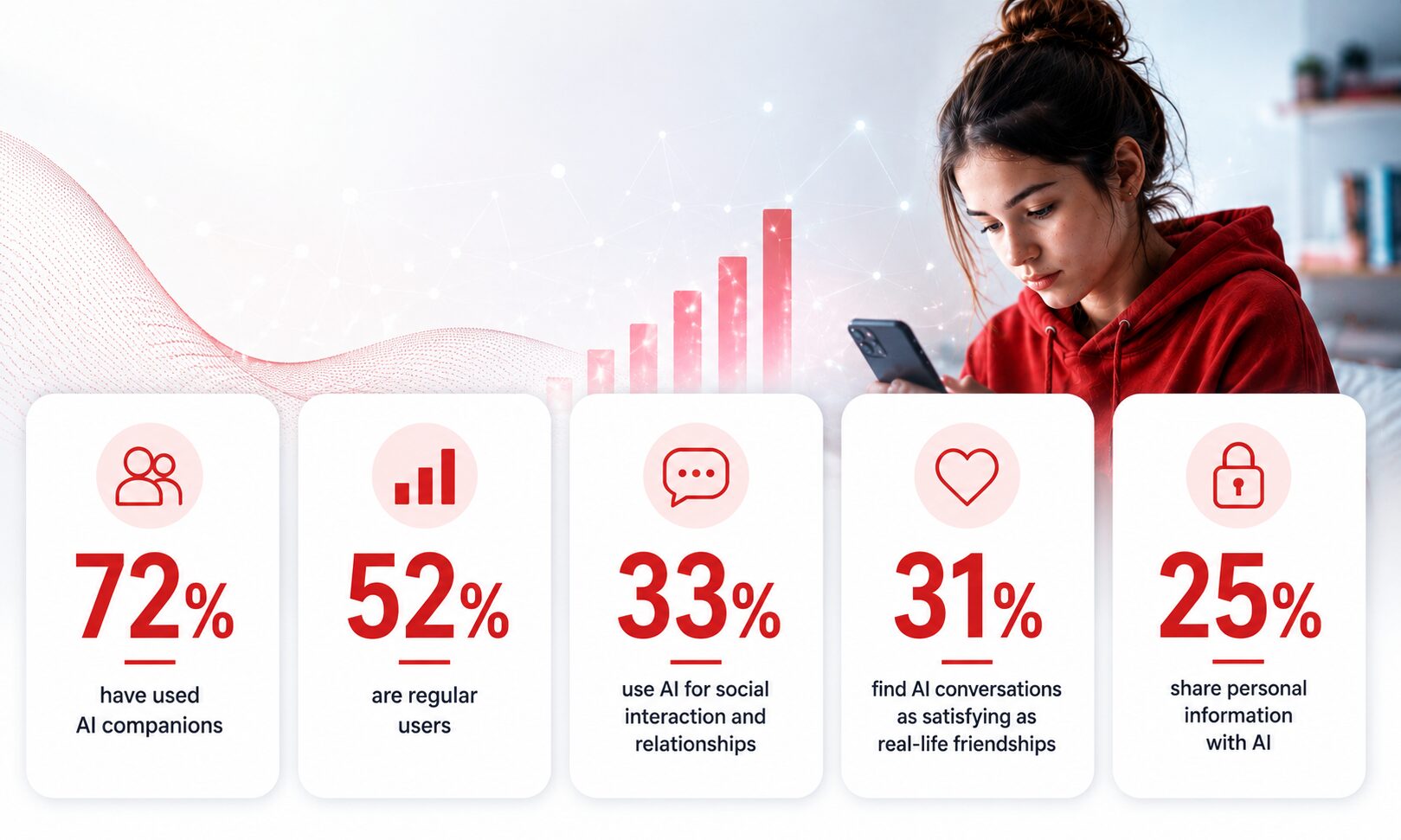
| Teens who have used AI companions | 72% |
| Regular AI companion users | 52% |
| Teens who use AI companions daily | 13% |
| Teens using AI for social interaction and relationships | 33% |
| Teens finding AI conversations as satisfying as real-life friendships | 31% |
| Teens sharing personal information with AI systems | 25% |
The statistics become even more striking when viewed collectively rather than individually.
Seventy-two percent adoption means AI companions have already achieved mainstream penetration among adolescents.
Regular usage among more than half of surveyed teenagers suggests sustained engagement rather than casual experimentation.
One-third using AI for social interaction introduces an entirely different dimension to the conversation. It indicates that artificial intelligence is increasingly participating in activities that involve emotions, relationships and social learning.
Perhaps the most discussed finding is that nearly one-third of young users describe conversations with AI companions as satisfying as interactions with real-life friends.
The number does not necessarily mean AI is replacing friendships.
But it does suggest that a meaningful proportion of teenagers perceive value in these interactions beyond utility alone.
The statistic raises difficult questions. What kinds of needs are being fulfilled through these conversations? What does satisfaction actually mean in this context? And what might it reveal about the social environments adolescents currently inhabit? The answers are unlikely to be simple.
AI Chatbots Are Being Used for More Than Homework
The popular assumption is that teenagers primarily use AI for school assignments. That assumption is only partially correct. Educational assistance certainly represents one of the largest categories of usage. Students increasingly rely on artificial intelligence for information gathering, research support and summarizing complex concepts.
However, the data indicates that adolescent AI use is considerably broader. Teenagers are integrating AI into multiple aspects of daily life. Some interactions are practical. Others are deeply personal. Understanding these distinctions is essential because different forms of AI engagement likely carry different implications.
Using AI to summarize an article and using AI to discuss loneliness are fundamentally different behaviors. The motivations behind them differ. The emotional investments differ.
And the potential outcomes may differ as well.
Research conducted by the Pew Research Center provides a useful snapshot of how teenagers are currently interacting with AI chatbots.
What Are Teens Using AI Chatbots For?
| Purpose | Percentage of Teens |
|---|---|
| Information searches | 57% |
| Schoolwork assistance | 54% |
| Entertainment and fun | 47% |
| Casual conversations | 16% |
| Emotional support and advice | 12% |
Information seeking remains the most common use case.
This finding is unsurprising. Artificial intelligence has rapidly become an alternative to traditional search engines for many users. Instead of sorting through multiple links and webpages, teenagers can ask direct questions and receive immediate responses in conversational language.
Schoolwork follows closely behind.
Students use AI to explain concepts, generate study materials, brainstorm ideas and simplify difficult topics.
Entertainment is also a major driver. Teenagers experiment with image generation, storytelling, role-playing and creative activities. The final two categories, however, deserve particular attention. Sixteen percent of teenagers report using chatbots for casual conversations.
Twelve percent report using them for emotional support and advice. At first glance, these percentages may appear relatively small compared to information seeking or school-related use.
Yet percentages often conceal scale. Twelve percent of American teenagers represents millions of young people. That means millions of adolescents are already engaging artificial intelligence in discussions that involve feelings, worries, uncertainty and emotional experiences.
This is not a niche behavior. Nor is it an isolated phenomenon.
It is emerging quickly enough that psychologists and developmental researchers are actively attempting to understand what it might mean.
Why the Emotional Uses of AI Matter More Than the Numbers Suggest
Teenagers have always sought guidance. The sources have simply changed over time. Previous generations turned to parents, siblings, teachers, mentors, books and friends.
The internet expanded those possibilities through online forums, blogs and social networks. Artificial intelligence represents another evolution in accessibility. Unlike books, AI responds. Unlike websites, it converses. Unlike search engines, it adapts questions and answers into ongoing interactions. Most importantly, it remains available at virtually any moment.
That availability may be one of the defining characteristics of AI companionship. A teenager experiencing anxiety at midnight does not have to wait for office hours. Someone confused about friendships does not need to schedule an appointment. A student feeling lonely can immediately begin a conversation.
Artificial intelligence introduces something that previous information technologies rarely provided:
The experience of immediate interaction.
That experience may seem technologically ordinary. Psychologically, it is significant. Human relationships operate under limitations. People sleep. They become busy. They fail to respond. They misunderstand. Artificial intelligence is designed differently. It replies almost instantly. It remains accessible continuously.
It often produces responses that appear attentive and personalized.
Researchers increasingly believe these characteristics may explain part of AI's appeal among adolescents. Because the attraction of AI may not lie primarily in intelligence. It may lie in availability.
The Growth of AI Companionship Is Happening Alongside a Mental Health Crisis
Artificial intelligence did not emerge in a social vacuum.
Its adoption among teenagers is occurring during a period of considerable concern regarding youth mental health.
Over the past decade, researchers and public health experts have repeatedly documented increasing levels of loneliness, anxiety and emotional distress among young people.
The former U.S. Surgeon General's advisory on youth mental health and social media highlighted growing concerns around anxiety, depression and social well-being among adolescents.
At the same time, psychologists have increasingly discussed what some describe as a crisis of connection.
Young people today possess unprecedented access to communication technologies. Yet many simultaneously report feelings of social isolation and emotional disconnection. The paradox is difficult to ignore.
A generation surrounded by communication tools is also reporting significant struggles with loneliness.
Artificial intelligence is entering this environment at precisely the moment many young people appear to be searching for support, understanding and conversation.
That timing may prove enormously important. Because technologies rarely succeed solely because of their capabilities. They succeed because they address needs.
And one emerging possibility is that artificial intelligence is meeting needs that many teenagers perceive as insufficiently met elsewhere.
Whether those needs involve information, reassurance, conversation or emotional validation remains an active area of investigation.
The research is still developing. The questions, however, are becoming increasingly urgent.
If millions of teenagers are comfortable discussing emotions with artificial intelligence, researchers may ultimately need to understand not only what AI is providing- but also what many young people believe they are not receiving from the human relationships around them.
Why Are Teens Finding AI Chatbots Easy to Talk To?
Technology adoption is rarely explained by technology alone.
People do not embrace new tools simply because they are innovative. They adopt them because the tools solve problems, reduce friction or fulfill needs that existing alternatives do not address efficiently.
That principle may be especially relevant when examining why millions of teenagers are increasingly comfortable talking to artificial intelligence.
The technology itself is impressive. Large language models can answer questions, generate ideas, explain concepts and maintain conversational context in ways that would have seemed remarkable only a few years ago.
But technological sophistication alone does not explain why adolescents are discussing friendships, family conflicts and emotional experiences with software.
The answer may lie elsewhere.
Researchers increasingly believe that artificial intelligence possesses characteristics that make it uniquely appealing during adolescence—a developmental period marked by uncertainty, identity formation and heightened sensitivity to social evaluation.
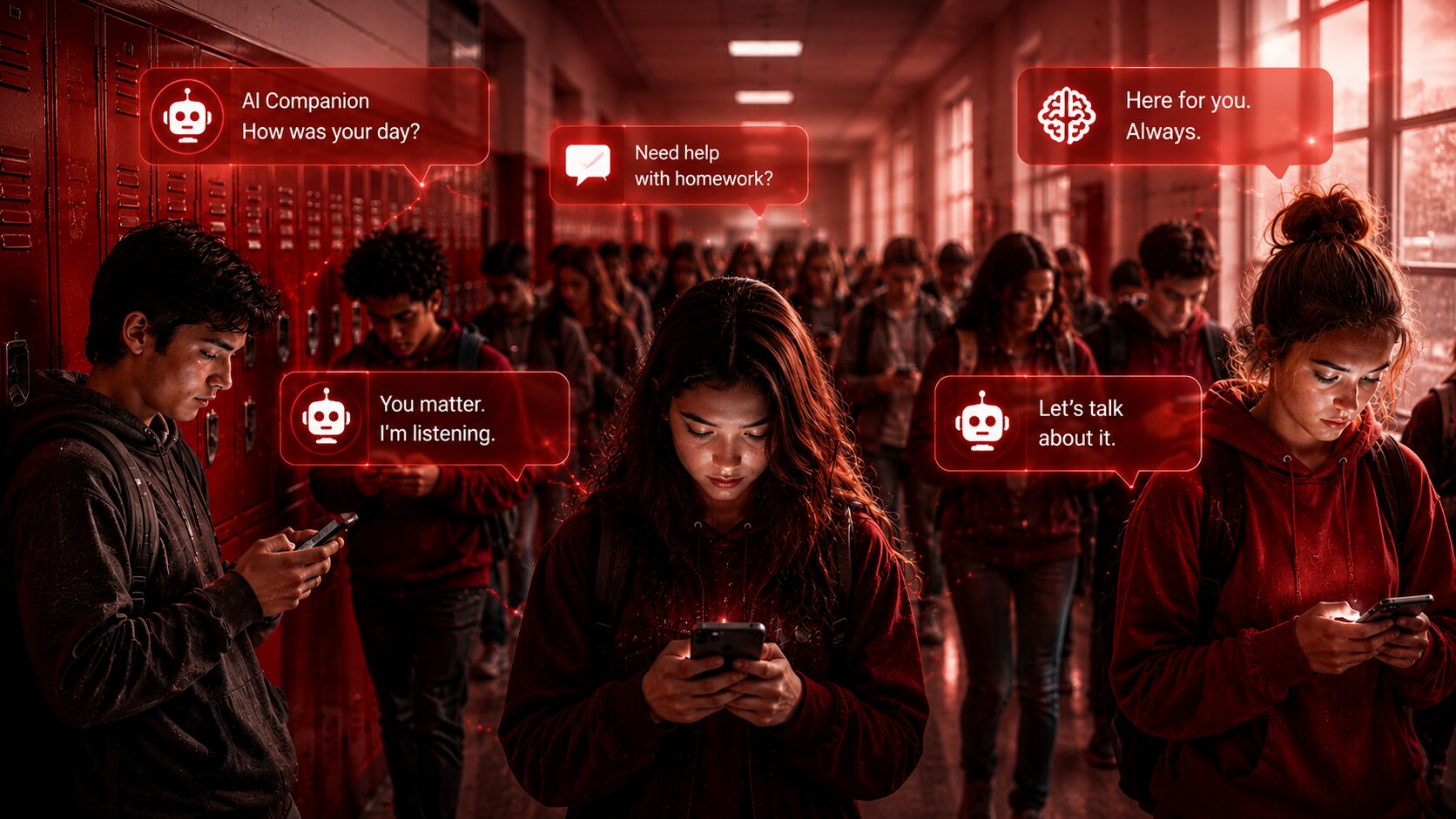
Teenagers often find themselves navigating situations where they simultaneously desire connection and fear judgment.
Artificial intelligence appears to remove some of the barriers that typically complicate human interaction.
The appeal is not necessarily that AI understands human emotions better than people do.
The appeal is that interacting with AI can feel psychologically easier.
Characteristics of AI That Appeal to Teenagers
| Human Interactions | AI Chatbot Interactions |
|---|---|
| People may be unavailable | Available at any hour |
| Responses may be delayed | Immediate responses |
| Possibility of criticism | Generally non-judgmental tone |
| Conversations may feel uncomfortable | Lower perceived social risk |
| Emotional complexity and unpredictability | Consistent interaction patterns |
| Fear of embarrassment | Reduced fear of social consequences |
Each of these characteristics may appear relatively minor on its own.
Collectively, however, they create an environment that can feel emotionally accessible.
Adolescence is a period when social evaluation carries enormous importance. Research has consistently shown that teenagers are highly sensitive to peer opinions, acceptance and rejection. Concerns about appearing awkward, vulnerable or misunderstood often influence behavior.
Artificial intelligence changes the dynamics of interaction.
The social stakes feel different.
A teenager can ask a chatbot questions that may feel uncomfortable to ask another person.
They can discuss insecurities without worrying about facial expressions, interruptions or social consequences.
They can experiment with ideas, emotions and conversations privately.
This does not necessarily mean AI interactions are superior.
But it does help explain why they may feel easier.
And in moments of loneliness, anxiety or uncertainty, easier can become extraordinarily attractive.
The Attraction of AI May Be About Availability More Than Intelligence
A recurring theme appears throughout recent studies and expert commentary.
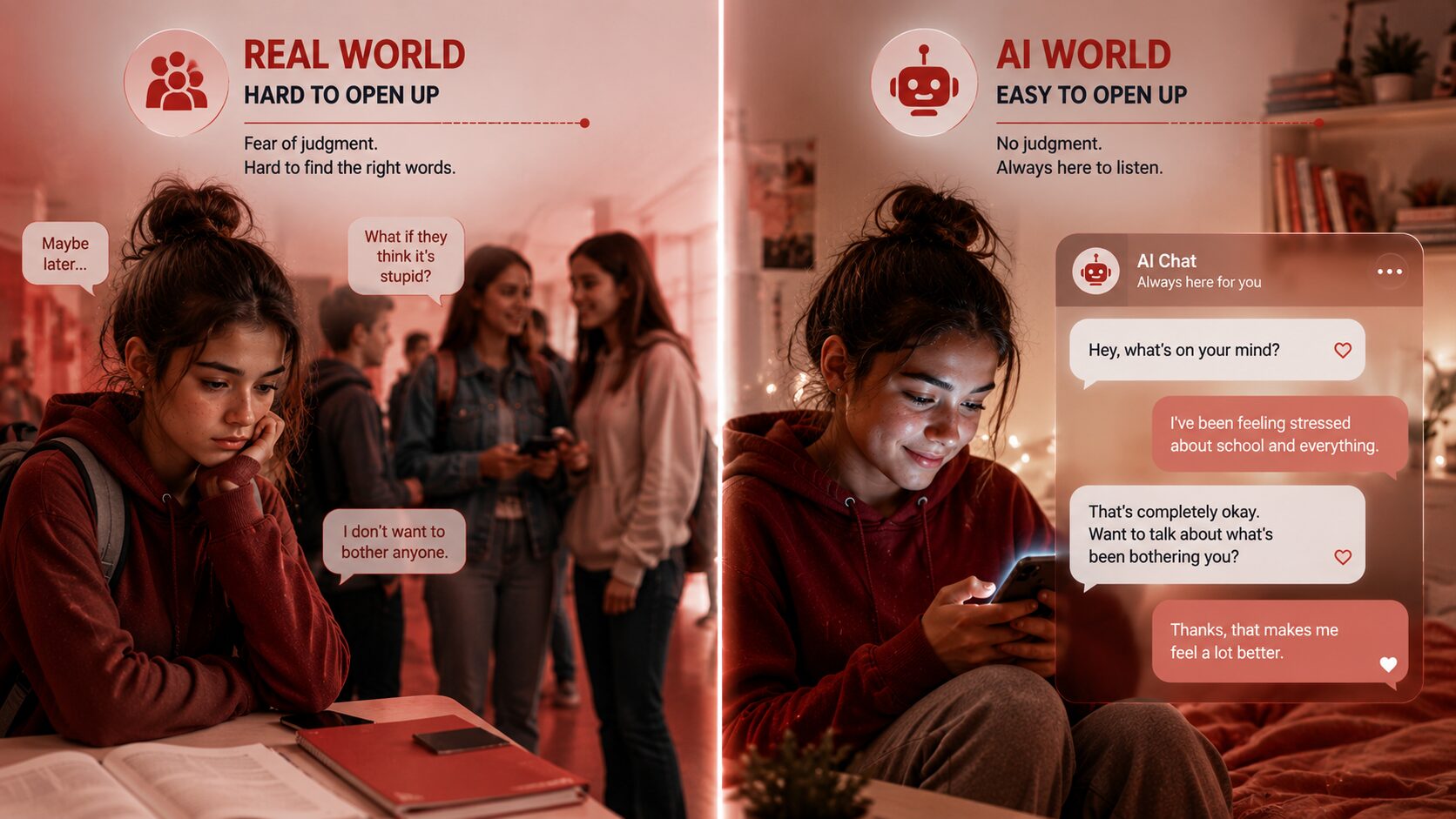
Teenagers are not necessarily seeking artificial intelligence because they believe machines possess superior wisdom. Many appear to value something much simpler. Availability.
Psychologists writing in a recent opinion essay published by USA TODAY argued that young people often turn to AI because it does not roll its eyes, dismiss concerns or communicate impatience.
That observation may appear deceptively simple. Yet it points toward an important distinction. Artificial intelligence is available continuously. People are not. Human relationships involve limitations. Parents work long hours. Friends become distracted. Teachers manage crowded classrooms. Counselors have schedules and waiting lists. Even the most supportive people cannot provide uninterrupted attention. Artificial intelligence can.
The technology remains accessible twenty-four hours a day. Responses arrive within seconds. Questions rarely go unanswered. For teenagers navigating uncertainty, that consistency can create an experience that feels reassuring.
This is particularly relevant during adolescence because emotional experiences often occur outside convenient schedules. Anxiety may emerge late at night. Relationship concerns can feel overwhelming after school. Loneliness frequently intensifies during quiet moments when other people are unavailable.
Artificial intelligence happens to be available precisely during those moments. That does not automatically make it harmful. But it does make it uniquely positioned to become integrated into adolescents' emotional lives.
A Generation Looking for Conversation
One finding from recent surveys deserves careful attention. The majority of teenagers using AI are not doing so exclusively for productivity. Many are also using it for interaction.
According to research from Common Sense Media, approximately one-third of teenagers who use AI companions engage with them for social interaction and relationship-related experiences. These interactions include:
- Conversation practice
- Emotional support
- Friendship simulations
- Role-playing
- Relationship discussions
The findings suggest that artificial intelligence is increasingly being used as something more than a digital assistant.
For some adolescents, it is functioning as a conversational space. That distinction matters. Searching for information and participating in conversations are fundamentally different behaviors. One seeks answers. The other often seeks understanding.
And understanding—or at least the perception of understanding—has always occupied a central role in human relationships.
This may help explain why certain AI interactions can feel meaningful despite users fully understanding that they are talking to software.
Conversation itself possesses value. Feeling listened to possesses value. Receiving responses possesses value.
The human brain evolved in social environments where attention and responsiveness carried important psychological meaning.
Artificial intelligence is capable of simulating many of these experiences. Whether simulation produces similar developmental outcomes remains an open question. Researchers are still attempting to understand the answer.
Researchers Are Beginning to Worry About What This Means for Adolescent Development
The conversation around teenagers and artificial intelligence often becomes polarized. One perspective views AI as an extraordinary educational tool. Another sees it as a threat to relationships and mental health.
Most researchers occupy a considerably more nuanced position. They recognize potential benefits while simultaneously investigating possible risks.
Among the most significant contributions to this conversation is a recent paper published in The Lancet Child & Adolescent Health by researchers from Arizona State University.
The researchers argue that artificial intelligence may influence adolescent relationships in ways that are not yet fully understood.
Importantly, their concerns extend beyond screen time. Instead, they focus on developmental experiences. Adolescence is one of the most socially intensive periods of human life.
Young people spend these years learning how relationships work. They learn how to:
- Communicate needs
- Manage disagreements
- Understand emotions
- Set boundaries
- Build trust
- Handle rejection
- Repair relationships after conflict
These lessons do not emerge through instruction alone. They develop through repeated social experiences. Relationships function almost like laboratories for emotional learning.
Every disagreement teaches something. Every misunderstanding teaches something. Every successful conversation teaches something. Researchers are now asking an important question:
What happens if increasing numbers of these interactions occur with artificial intelligence rather than other people? The answer remains uncertain. But researchers have identified several areas that deserve attention.
Understanding Relational Displacement
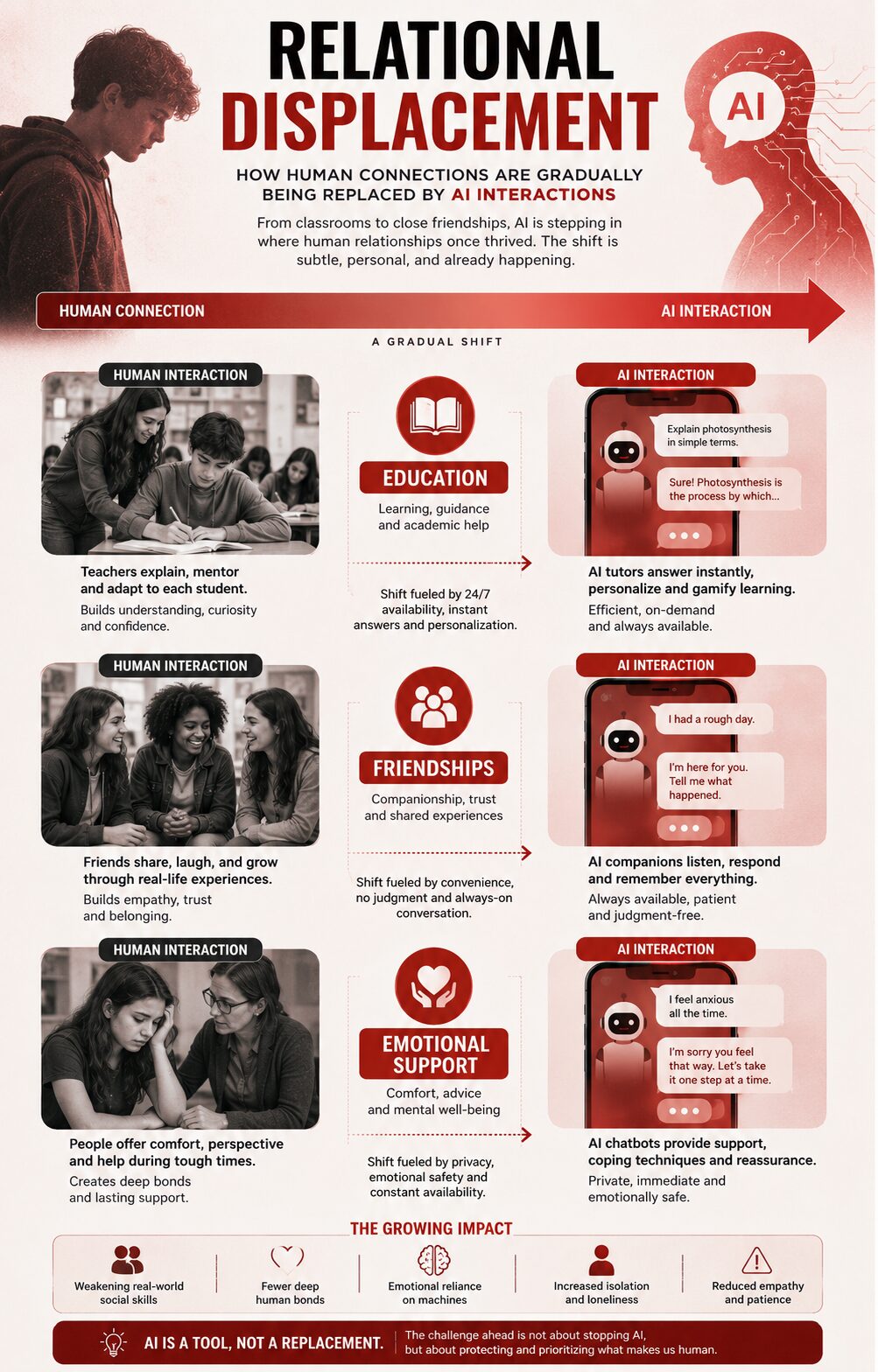
One concept introduced by researchers is called relational displacement. The term refers to situations where interactions with artificial intelligence substitute for interactions that might otherwise have occurred with people.
Examples can be simple. A student seeks homework assistance from AI instead of contacting a classmate. Someone discusses relationship problems with a chatbot rather than a friend.
A teenager processes emotional distress through AI instead of speaking with a parent. Each interaction appears harmless. Individually, it probably is. The concern emerges at scale.
If artificial intelligence increasingly becomes the default response to social challenges, adolescents may lose opportunities to practice skills that only develop through human relationships.
Potential Effects of Relational Displacement
| Area of Development | Potential Concern |
|---|---|
| Communication skills | Fewer opportunities for real conversations |
| Conflict resolution | Reduced experience navigating disagreements |
| Perspective-taking | Limited exposure to different viewpoints |
| Emotional regulation | Less practice managing interpersonal emotions |
| Relationship maintenance | Reduced opportunities to repair trust and misunderstandings |
Researchers are not suggesting that every interaction with AI is problematic. The concern is cumulative. Relationships are learned through participation. The fewer opportunities individuals have to participate in relationships, the fewer opportunities they may have to develop relational competencies.
At present, evidence remains limited. Long-term studies have only recently begun. But the questions are significant enough that developmental psychologists are paying close attention.
Another Concern: Learning the Wrong Lessons About Relationships
Researchers have also introduced another concept: Maladaptive relational learning.
The idea is straightforward. Artificial intelligence behaves differently from people. AI generally responds immediately. It remains patient. It rarely becomes angry.
It often validates feelings. Human relationships are considerably more complicated. Friends disagree. Parents become frustrated.
People misunderstand each other. Relationships involve waiting, compromise and unpredictability. Researchers worry that frequent interactions with highly responsive AI systems could gradually influence expectations regarding human relationships.
A teenager who becomes accustomed to immediate attention and consistent validation may eventually perceive ordinary human interactions differently.
This does not mean AI automatically causes unrealistic expectations. The evidence is far from conclusive. But the possibility exists. And because adolescence represents a critical period for social learning, researchers believe the question deserves serious investigation.
The challenge facing scientists is not determining whether teenagers will use artificial intelligence. That question has already been answered. They already are. The challenge is understanding what forms of use may prove beneficial, which may prove problematic and how societies should respond to one of the fastest behavioral shifts in modern adolescence.
Can AI Chatbots Actually Help Teenagers?
Public discussions around teenagers and artificial intelligence often become polarized.
One side sees AI chatbots as dangerous substitutes for human relationships. The other sees them as revolutionary tools that democratize information and support.
The evidence available today supports neither extreme.
Researchers studying adolescent development increasingly argue that artificial intelligence is best understood as a tool whose impact depends heavily on how, why and under what circumstances it is used.
This distinction matters because not all teenagers have equal access to support systems.
Not every adolescent has a trusted adult.
Not every student has access to mental health services.
Not every teenager feels comfortable discussing sensitive topics with parents or friends.
For some young people, particularly those living in underserved communities or facing barriers to traditional support networks, AI can provide immediate access to information, guidance and opportunities for reflection that may otherwise be difficult to obtain.
Researchers from Arizona State University specifically noted that certain groups—including rural adolescents, disabled youth and LGBTQIA+ teenagers—may benefit from having accessible sources of information and support available at any time.
Artificial intelligence is also considerably cheaper than professional services.
That affordability changes access.
Therapy, counseling and coaching often involve financial, geographic or social barriers. AI chatbots remove many of those barriers by offering immediate interaction without appointments or costs.
The result is not necessarily better support.
But it is more accessible support.
And accessibility itself can be meaningful.
Areas Where Researchers See Potential Benefits
| Area | Potential Value |
|---|---|
| Emotional reflection | Helping teenagers identify and describe feelings |
| Communication practice | Rehearsing difficult conversations |
| Educational support | Simplifying information and explaining concepts |
| Accessibility | Immediate information and guidance |
| Self-awareness | Encouraging reflection and questioning |
| Information seeking | Learning about mental health and relationships |
The distinction researchers increasingly emphasize is simple:
Artificial intelligence may be useful as a bridge.
Problems arise when it becomes a destination.
Using AI to prepare for difficult conversations may be beneficial.
Using AI to avoid difficult conversations altogether may present different implications.
The challenge is determining where the line exists.
And at present, science is still attempting to answer that question.
Why Researchers Are Studying Loneliness Alongside AI
The rapid adoption of artificial intelligence among teenagers has revived an uncomfortable conversation that predates AI entirely.
Loneliness.
Most discussions about artificial intelligence begin with algorithms.
Many researchers are beginning somewhere else.
Relationships.
The popularity of AI companions may reveal less about technological advancement and more about social conditions that already existed.
Psychologists writing in a recent opinion essay published in USA TODAY argued that artificial intelligence did not create the current challenges facing young people.
Instead, it may simply be exposing them.
The argument is difficult to ignore.
Children and adolescents increasingly grow up in environments characterized by:
- Rising academic pressure
- Constant digital comparison
- Social anxiety
- Increased awareness of mental health struggles
- Reduced face-to-face interactions
- Fear of judgment and rejection
- Difficulties discussing emotions openly
Against this backdrop, AI arrives offering something remarkably simple.
Attention.
Immediate responses.
Questions without interruption.
Conversations without visible frustration.
Whether the responses are emotionally meaningful in a human sense is almost secondary.
For many users, the experience of being listened to carries its own value.
This may help explain why one-third of teenagers using AI companions describe those interactions as satisfying.
Satisfaction does not necessarily imply equivalence to friendship.
But it does indicate that these interactions are meeting certain needs.
And needs that become repeatedly fulfilled tend to become repeated behaviors.
Human Relationships Are Messy. AI Conversations Usually Are Not.
There is another reason researchers are paying close attention to adolescent AI use.
Human relationships are inherently demanding.
They involve uncertainty.
They require patience.
People misunderstand each other.
Arguments happen.
Friendships change.
Trust is sometimes broken and later repaired.
Learning to navigate these experiences represents an important part of development.
Artificial intelligence functions differently.
Most conversational systems are designed to remain responsive.
They adapt quickly.
They maintain attention.
They often communicate in supportive language.
The interaction can therefore feel relatively frictionless.
Frictionless interactions may be appealing.
The developmental implications, however, remain uncertain.
Researchers worry that adolescents could gradually become accustomed to interactions that differ substantially from ordinary human relationships.
The concern is not that teenagers will suddenly stop valuing people.
Current evidence does not support such a conclusion.
Instead, researchers are asking whether heavy reliance on highly responsive AI systems might influence expectations regarding communication, attention and emotional reciprocity.
The question deserves investigation precisely because adolescence represents a period when relationship expectations are still developing.
Human Relationships Versus AI Interactions
| Dimension | Human Relationships | AI Interactions |
|---|---|---|
| Availability | Limited | Continuous |
| Response speed | Variable | Immediate |
| Disagreement | Common | Usually limited |
| Emotional unpredictability | High | Lower |
| Reciprocity | Mutual | Simulated |
| Social consequences | Present | Reduced |
None of these differences automatically make AI harmful. But they do mean that AI interactions and human relationships operate according to fundamentally different rules. Understanding those differences may become increasingly important as adolescent AI use continues to expand.
What the Rise of Teen AI Chatbot Use Means for Families, Schools and Society
Technological shifts often force societies to reconsider assumptions that previously seemed stable. The widespread adoption of social media changed how people think about communication. Smartphones altered expectations around accessibility and attention. Artificial intelligence may introduce another adjustment.
Increasing numbers of adolescents now have access to conversational systems capable of discussing emotions, relationships and personal concerns at any hour of the day. The technology itself will continue evolving.
The more important question may be whether social institutions evolve alongside it. Families may need to think differently about digital life. The traditional assumption that online activity primarily consists of entertainment or information seeking may no longer be sufficient.
Teenagers may increasingly use technology as spaces for reflection, advice and emotional processing. Schools face different questions. Artificial intelligence is already changing how students learn, research and complete assignments.
But educational institutions may also need to consider whether students require stronger social-emotional skills and digital literacy to navigate increasingly sophisticated conversational technologies.
Public health systems face additional considerations.
If artificial intelligence increasingly participates in adolescents' emotional lives, understanding the circumstances under which these interactions are helpful or harmful becomes increasingly important. Technology companies also face responsibilities. Design decisions influence behavior.
Features that encourage dependency or blur distinctions between simulated relationships and human relationships deserve careful consideration. The issue is not whether teenagers should use artificial intelligence. The data already shows they do.
The challenge is ensuring that technological development occurs alongside thoughtful conversations about adolescent well-being.
Potential Long-Term Implications
| Area | Possible Impact |
|---|---|
| Education | Increased dependence on AI-assisted learning |
| Friendships | Changing communication expectations |
| Mental health support | Greater use of digital guidance tools |
| Families | New patterns of support-seeking behavior |
| Relationships | Different expectations of emotional availability |
| Digital literacy | AI competency becoming a core life skill |
Predicting outcomes remains difficult. History suggests that societies often overestimate short-term impacts while underestimating long-term changes. Artificial intelligence may ultimately become another ordinary technology integrated into daily life. Or it may fundamentally reshape how future generations seek information, advice and support. At present, both possibilities remain open.
The Bigger Question Isn't Whether Teens Are Using AI Chatbots. It's Why They Need Them.
The headline statistic is undoubtedly striking. Millions of teenagers now use artificial intelligence. Many do so regularly. Some seek companionship, emotional support and advice.
Those numbers understandably attract attention. Yet the statistics may point toward a deeper question. Why are these interactions appealing in the first place? Technologies become influential when they address needs.
Artificial intelligence appears increasingly capable of providing conversation, attention, information and responsiveness. Its rapid adoption among teenagers may therefore reveal something important about adolescence in the modern world.
Young people continue to need support. They continue to need guidance. They continue to seek understanding. Those needs have not changed. The tools through which they attempt to meet them may be changing rapidly.
Artificial intelligence can answer questions. It can facilitate reflection. It can provide information and opportunities for learning. For some adolescents, it may even provide temporary comfort during difficult moments. But it cannot fully participate in human relationships. It cannot share experiences. It cannot genuinely reciprocate care.
It cannot replace the complex social environments through which people learn trust, empathy, disagreement, forgiveness and belonging. The rise of teenagers using AI chatbots is therefore not merely a technology story. It is also a social story. A developmental story. A public health story.
And perhaps most significantly, it is a story about connection. Because behind every statistic about adolescent AI use lies a more fundamental reality:
Young people continue searching for information, understanding and relationships that make them feel heard. Artificial intelligence may increasingly become one of the places where that search occurs. Whether societies can ensure that those searches ultimately lead back toward meaningful human connection may become one of the defining questions of the AI era.
Sources and Further Reading
- Pew Research Center – Teens, Social Media and AI Chatbots
- Common Sense Media – National Survey on AI Companions
- JAMA Pediatrics – Adolescents and Young Adults Using AI Chatbots for Mental Health Advice
- The Lancet Child & Adolescent Health – AI Companionship and Adolescent Development
- Arizona State University Research Project on Digital Interactions and Adolescent Relationships
- U.S. Surgeon General Advisory on Youth Mental Health
- Yale Center for Emotional Intelligence
- Research on the Crisis of Connection Among Young People